A Timeline of Shark Conservation in the Mexican Caribbean: a movement that transformed the relationship between science, community, and the sea
Shark conservation in the Mexican Caribbean did not emerge from a single project, but from a collective process that has evolved over three decades. Driven by scientists, divers, fishers, and civil society organizations, this movement found a strategic operational axis in Saving Our Sharks Foundation, whose work has marked a turning point in the protection of these keystone species essential to ocean balance.
Origins: curiosity, science, and early encounters (1997–2010)
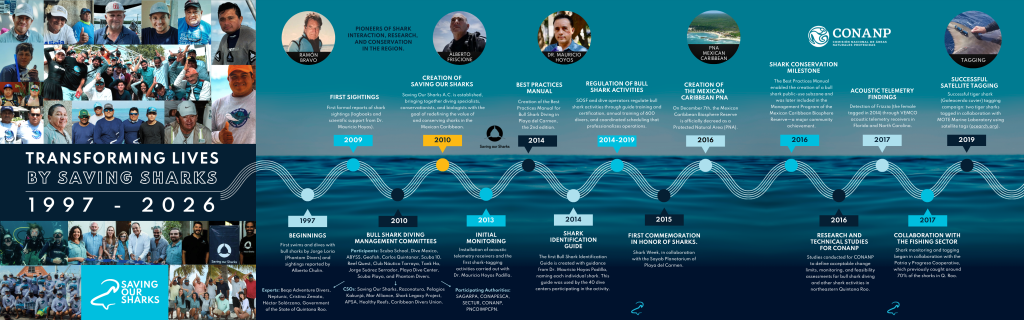
The earliest foundations of shark diving in the region are linked to pioneers such as Ramón Bravo and Alberto Friscione, who helped shape the understanding of the ecological and tourism value of sharks.
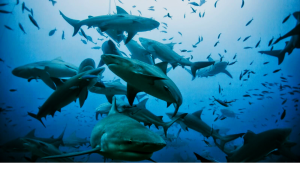
In 1997, the first documented swims, sightings, and dives with bull sharks in the Mexican Caribbean were recorded through the efforts of local dive guides and centers. These initial encounters opened the door to a new paradigm: observing rather than extracting.
By 2009, the first formal sighting records began to be compiled through scientific logbooks, with the support of specialists such as Dr. Mauricio Hoyos, enabling a transition from anecdotal observations to systematic data collection.
2010: The founding of Saving Our Sharks
In 2010, Saving Our Sharks A.C. was formally established, bringing together divers, biologists, conservationists, and experts with a clear objective: to revalue and conserve sharks in the Mexican Caribbean.
That same year, the first community meetings were held to organize and regulate bull shark diving activities in key destinations such as Playa del Carmen, engaging dive centers, cooperatives, and authorities including SAGARPA, CONAPESCA, SECTUR, CONANP, and PNCOIMPCPN.
Participating dive centers: Phantom Divers, Alberto’s Scuba, Pepe Dive Center ,UWE Underwater Expeditions,Phocea México, Dive Mike, Yucatek Diver, Pro dive, Buceo Xtabay, Dressel Divers, Solo Buceo, Scuba Libre, Scuba Maroma, Playa Scuba, Scuba 10, Pluto Dive, WetSet, Deep Down Media, Sand Dollar Sports, Scuba Maroma , México Blue Dream, Ecodiving Tours, DiveMex, Dive Zone, Bullsharks Diving Center, Dos Ojos Scuba, O2 México, Reef Marina, Playa Diving Center, Dive Life, Mexidivers, Playa Diving Center, Gran Scuba, .
This collaborative approach was crucial: conservation evolved from an isolated initiative into a participatory model grounded in science and community engagement.
2013–2016: Applied science and community regulation
In 2013, acoustic telemetry receivers were deployed and the first bull shark tagging efforts were conducted, allowing researchers to monitor movements and better understand behavioral patterns. This scientific advancement strengthened a management model integrating research, monitoring, and responsible tourism.
In 2014, the Best Practices Manual for bull shark diving was developed in collaboration with dive centers, authorities, and experts. During this period, the first Bull Shark Identification Guide was also created, naming individual sharks and reinforcing long-term monitoring.
A major milestone occurred in 2016 with the designation of the Reserva de la Biosfera Caribe Mexicano, where the community-developed manual was incorporated into the official management program, formally recognizing the collective conservation effort.
2017–2019: Research and model consolidation
Between 2017 and 2019, technical and scientific studies were conducted in collaboration with CONANP, focusing on nursery areas, population monitoring, and the regulation of shark diving tourism.
At the same time, tagging campaigns and training programs were implemented, reaching up to 600 divers per season and establishing operational and safety standards.
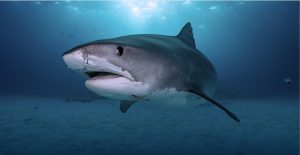
In 2019, a successful tiger shark satellite tagging campaign was carried out in partnership with Mote Marine Laboratory, expanding scientific knowledge on pelagic shark species in the region.
2021–2025: Expansion through Saving Our Sharks Foundation
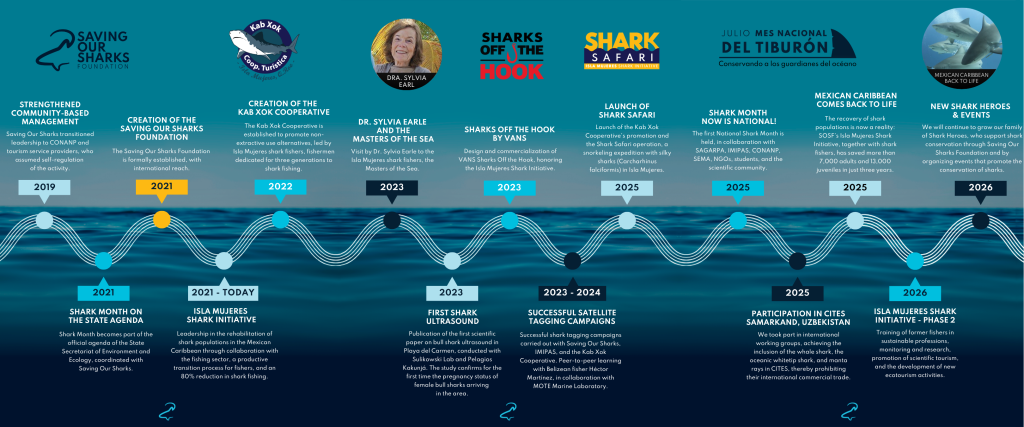
In 2021, Saving Our Sharks Foundation was formally established with an international scope, alongside the Isla Mujeres Shark Initiative, focused on population rehabilitation through the productive transition of the fishing sector and a significant reduction in shark fishing.
This effort led to the creation of the Kab Xok Cooperative, representing a historic shift: traditional shark fishers, with generations of experience, transitioned toward non-extractive models such as sustainable tourism, becoming “Guardians of the Sea” guided and trained by the Foundation.
In 2023, the first scientific ultrasound study on bull sharks in the region was published, and the visit of Dr. Sylvia Earle further strengthened the project’s international recognition.
Building on decades of collective work, Shark Month was integrated into the state’s official environmental agenda, coordinated by Saving Our Sharks and more than 166 cross-sector alliances, with over 50 activities nationwide each July.
2025: The Mexican Caribbean comes back to life
Today, the rehabilitation of shark populations in the Mexican Caribbean is a measurable reality. In just three years, the Isla Mujeres Shark Initiative has contributed to saving more than 30,000 sharks, demonstrating that conservation rooted in science, community engagement, and sustainable economic alternatives is both viable and effective.
This timeline tells more than a sequence of events—it reflects a profound cultural transformation. From extraction to protection, from fear to respect, and from fishing to sustainable tourism. Thanks to the commitment of the community and its partners, sharks in the Mexican Caribbean now have a real chance of survival, and with them, the balance of the ocean and our shared future.
Contact us [email protected]or choose a way to support Saving our Sharks Foundation efforts:WAYS TO SUPPORT